In the publishing industry, the first rule they teach you is: “Find your genre.” They tell you that your genre defines your brand, and eventually, your name becomes shorthand for that shelf in the bookstore.
The problem? I don’t write for shelves. I write for people. And people rarely fit into a single category.
Themes are universal. They are the DNA of the human experience. You can take a theme like “Coming of Age” or “The Loss of Innocence” and place it on a starship, in a trench in WWI, or in a modern high school. The furniture changes, but the human truth remains the same.
Take Shakespeare’s Titus Andronicus. On the surface, it’s a Roman tragedy. But the engine driving it is a universal theme: The Romance of Corruption.
The Bard created a villainous bond between Tamora, Queen of the Goths, and Aaron the Moor. Their connection wasn’t defined by their politics, but by their shared lust for chaos. It was a love story, yes—but an “anti-social” one, forged in mutilation and secrecy. That theme—two outsiders united by their hatred of the civilized world—would work just as well in a Cyberpunk noir or a Western. The genre is the costume; the theme is the soul.
So, what is the universal theme that ties my disparate genres together?
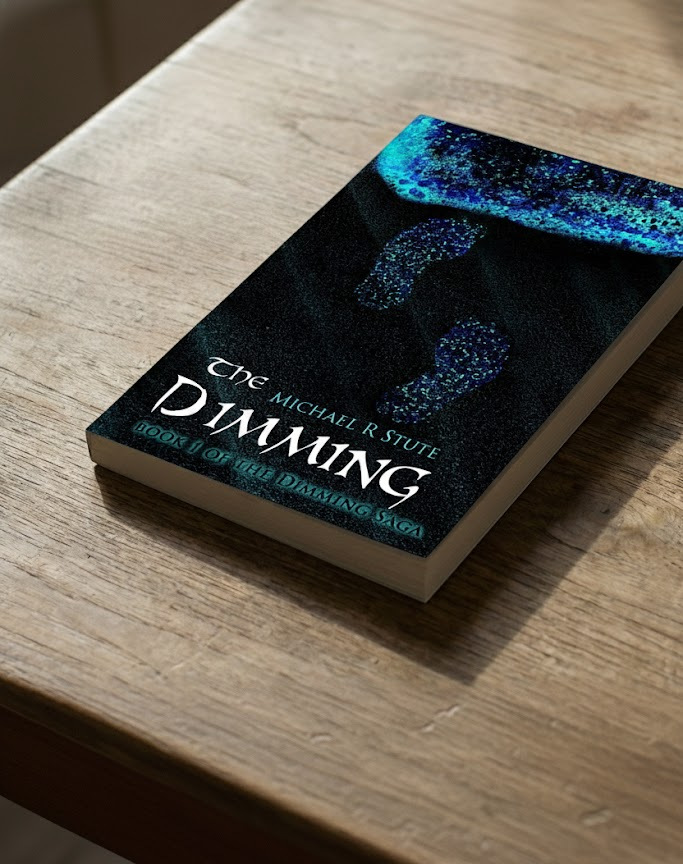
I have a medieval setting with horror elements in The Dimming Saga. I explore the high-tech near-future in Noise. My upcoming release, The Shape We Leave, is a saga of four seasons in a post-apocalyptic world.
They look different on the shelf. But they are all powered by the same universal engine: The Geometry of Survival.
If Titus explores how people are bound by corruption, my stories explore how people are bound by resilience.
In every book I write, the characters are forced into situations where morality is defined by the moment. Where every decision could lead to death—or worse, the death of someone they love. It’s about the perseverance of the human spirit. It’s about the kind of love that forces you to take another breath, even when you are certain there is no oxygen left.
That is the thread that runs from the glass cliffs of my medieval world to the server rooms of the near future. It’s not about who the characters are. It’s about who they become when the world falls apart.
While my work spans the medieval cliffs of The Dimming, the high-tech near-future of Noise – Sound the Gap, and the post-apocalyptic landscapes of my upcoming The Shape We Leave, the connective tissue isn’t the setting. It’s the theme.
Whether it’s a medieval climber facing a glass cliff or a modern man facing an AI that knows too much, I am interested in what happens to the human heart when the world is stripped away. I don’t write about people breaking things; I write about people trying to hold them together when everything else is falling apart.
In The Dimming Saga, the horror comes from the environment itself. In Noise, the threat is invisible and digital. In The Shape We Leave, the danger is flesh and blood. But in all three, the core question remains the same: Who do you become when the lights go out?
My characters are forced into situations where morality is defined by the moment. Where every decision could lead to death—or worse, the death of someone they love. It’s about resilience. It’s about the perseverance of the human spirit. It’s about the kind of love that forces you to take another breath, even when you are certain there is no oxygen left.
That is the Stute brand. It’s not about the swords, the code, or the apocalypse. It’s about the people holding the line.
Have you ever imagined a world where your morality was a luxury you could no longer afford?